I’ve done 100’s of decomposed granite patios and walkways in northern California and learned a few things as I went along.
When I first began, the industry didn’t have a ‘hardener’ that you could add. That made for a semi-successful installation, because in the winter your walkway was mushy at best. With the advent of hardeners, the DG comes out quite nice, with minimal mush.
Get the DG pre-mixed with the hardener (some landscape outfits will deliver like this) or mix on your own in a wheelbarrow per the proportion instructions.
Prepare a bed that’s about 5″ deep. Use an attractive edging. I am totally committed to Ryerson header, which is a thin hard steel that’s bendable. That’s because it disappears. It is expensive though, comes in 16′ lengths with its own stake.
The other plastic headers are ugly. An alternative are the many colors and types of Trek, which is a recycled plastic material. Use the 1/2″ wide size. The advantage is that its more bendable than the steel, but it doesn’t disappear, so its part of your project design.
For complete instructions, advice, questions and answers, see my eBook on how to install decomposed pathways and patios.
How to Build a Decomposed Granite Patio

Lay down several inches of road base and use a compacter to compact it very hard and tight. Order enough DG to lay down 2″ on top, compacted. Then here’s the secret: apply the DG (with the hardener mixed in good) at the rate of 1/2″ at a time.
Then compact. If you apply too thickly, the stuff won’t harden well. The DG has to be moist when putting it down, but not sloppy. Compact 1/2″ at a time till you have your desired height. Sprinkle with water.
Another method I’ve used quite successfully was told to me by the contractor at Strybing Arboretum in San Francisco. All their paths are done this way, and they get tons of traffic.
For this method, DON’T use hardener. Apply a good road base foundation of several inches, maybe 3 or 4″. Then apply only 1/2″-3/4″ of compacted DG. Essentially this is a dusting.
You will have to reapply every few years depending on your traffic. I used this method for a patio over 4 years ago and still have not reapplied. I think this is a superior method because you completely eliminate any winter mushiness. Even with a hardener there will be some mushiness.
Some warnings: DO NOT try to apply a hardener after the fact. I once went to a potential job where the gardener had installed a walkway, then put the hardener in after he was done. Oh my God! What a mess. The whole thing had to be removed and redone.

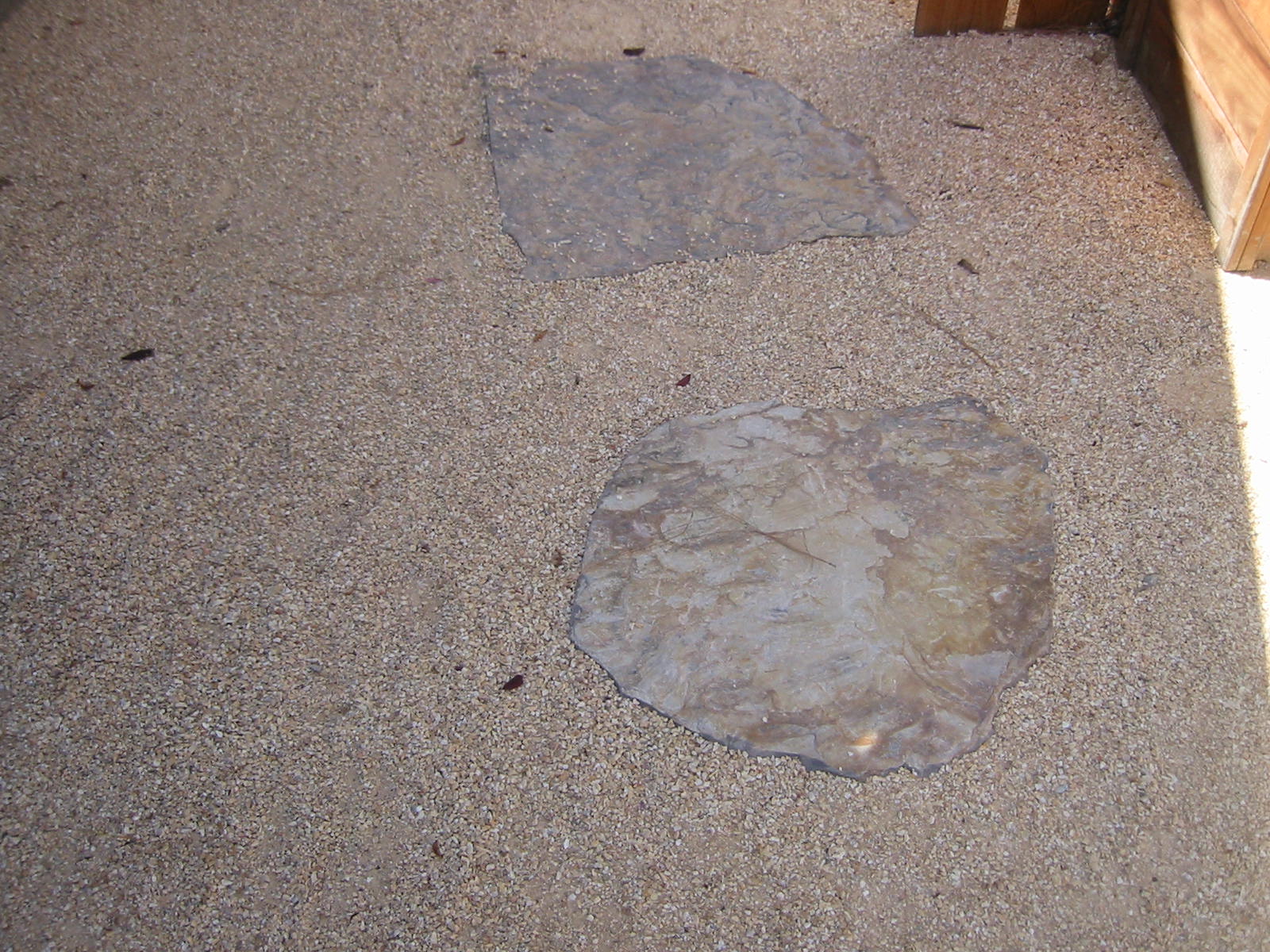
Next warning:- Do not install DG directly next to an indoor situation. DG tracks. It’s granite and granite gets on your shoes and gets in the house. You need at least a few steps (not many) before you go inside.
My son’s elementary school built a new gym for millions of dollars. The landscape architect speced DG as the hardscape all around the gym. That was a disaster. All those kids tracked that DG into the new hardwood floor and ruined it! They finally installed concrete as a spacer.

Next, the materials. Of course, every area is different. DG in the Bay Area came in gray, gold, or dirt brown. I’ve mixed them for different colors. Don’t be afraid to experiment a bit.
A new rock came out on the market from a local quarry that was cheaper (DG is expensive. Last I looked it was around $80/yard!). I was able to get ‘fines’ and used that successfully with the hardener for a coral color.


For patios, (see my complete post on patios)I usually don’t like to have a visible drain, so I put the drain(s) on the outside in the shrub area. The exceptions are like the previous post with the photo of the sunken patio. Of course, I had no choice. But really, always remember your drainage.
One neat new alternative to DG is permeable concrete. Its more expensive than ordinary concrete, but it is nicer, much nicer, on the environment. Its fairly new and my understanding is that a good powerwash in the spring opens the pores and keeps it permeable.

If you found this short entry useful, but need more information, click on this link for my full downloadable eBook on patios and walkways, priced at only $2.99. I’ve collected hundreds of real-life questions from do-it-yourselfers and all those questions will be answered in this short pamphlet.
I’ve also included information on DG pricing, colors, how to customize colors, and drainage. If you are not sure if you should use DG or another material.
I discuss the advantages and disadvantages of concrete patios and their preparation, mortared flagstone, flagstone on sand vs. flagstone with DG, as well as how to prepare gravel paths and patios.
Chock full of information in just 46 pages with additional color photos. If you like the eBook, please comment in the Amazon section. I appreciate all my readers and thank you all very much.

Read More Information about Decomposed Granite Stabilizer

 The Human Footprint
Just spritz when you are done compacting a few times a day for 2 or so days afterwards. Keeps it from cracking. You will be moistening your DG a bit at a time anyways–as much as you can in either a wheelbarrow or a mixer. It’s a lot easier if you obtain your DG pre-mixed with the hardener. They’ll do that for you at the yard. If you mix, then do it in a rented mixer because it’s important the hardener is well mixed in.
LikeLike
Thank you. We’ll give it a go!
LikeLike
Hello and Thank you for such great information. I ordered and read the guide for DG but just had a question regarding the border edging which I wasn’t able to find an example.
I would like my landscaping project without borders on the pathways. I’ve seen examples of borderless(path is next to mulched plant material) but does that mean that the edging has been install at or below grade so to hide the border with mulch? Would the installation be compromised if I attempted the arboretum method while doing so. Note: I do have a pallet of used red brick I can use but not sure if this would be adequate to hold the dg in place.
I appreciate your suggestions.
Thank you,
Doug in North San Diego
LikeLike
Hi Doug, I know of no way to contain the base rock and the DG without something there. Probably what you saw was a border that was thin and covered up. You certainly can experiment with different borders. The bricks will work as they are about 3.5″ thick. The metal border I propose is pretty much invisible. but you do need something to contain the DG or it will just mix with whatever is outside you walkway, slowly disappearing.
LikeLike
Hello and thank you. I have an upslope path I want to apply DG to. Would you recommend the ‘dusting’ method or to use hardener?
LikeLike
Either way you will get some run off and need to reapply the DG over time
LikeLike
Thank you Leslie. I figured nothing was permanent. I live in N. Cal and we as you know do get some hard rains, so perhaps hardener would be more resistant?
LikeLike
Depending upon your degree of slope you might consider TerreParve. That will set up like concrete and comes in many colors, but is permeable. See my post on that.
LikeLike
Thank you!
LikeLike
I’ve been getting estimates for DG with stabilizer walkways in my fairly flat backyard in Sacramento.
I’m having second thoughts because we have a large retriever who loves to race around the yard and play ball every minute of the day. This activity has ripped up our lawn and our drainage swale.
Now, I’m worried that “dog racing” will destroy the walkway in short order. What can you tell me about DG durability in this situation?
LikeLike
I had a young golden when I installed my own DG paths. Later on I had a crazy golden puppy too. Never really had any problems except my installation was before there was hardener and in the winter I’d get footprints during the rainy season. If you are very concerned, the I recommend you either use the Strybing method which would give you an incredibly hard base, but don’t use stabilizer OR use spray TerraKoat on afterwards. If you really are afraid, then just go to TerraPave, which is super hard, like concrete, but very permeable.
LikeLike
Hi there, thank you so much for this post, very informative! What is the general maintenance process? Ex: I have a large pine tree which drops pine needles constantly. I was thinking of putting DG below the tree (since grass won’t grow), but will be using a yard blower in that area regularly, to remove the pine needles. Will the blower also blow the DG? Thank you!
LikeLike
should be fine
LikeLike
I am considering adding DG to our backyard. I have a couple of questions:
1) Our kids would play on the surface. Does DG have fine, sharp edges, which would cut into skin more (than dirt) if a child falls onto it?
2) I’ve heard that granite can possess radon, which emits radioactivity. Is this the case with DG?
Thanks!
Arleen
LikeLike
Hi Arleen. Barefoot works great with DG. The base rock beneath is what’s hard on bare feet. In your case I’d go for my 2″ method. That way no need to reapply in 5 years.
Never heard about radon and DG. you’ll have to ask a geologist.
LikeLike
Thanks for your quick reply, Leslie! So if a child falls and slides on it, it sounds like it would not be much different than falling on a compacted dirt surface…?
LikeLiked by 1 person
That’s correct. It’s just like falling on dirt but certainly not as hard as concrete. I think it’s an excellent choice. But make sure your contractor installs EXACTLY like I recommend. If he doesn’t, then the result in rainy weather will be a mushy product. Just so you know, our local elementary school installed DG near the gym. That might make you feel better.
LikeLike
Hi Leslie,
I live in San Francisco and am looking for someone to do some installation work on our backyard. I can’t seem to find a bio on your site. Are you a gardener / landscaper for hire? If yes, how can I get in touch with you directly to discuss possibly providing us with a quote?
If you’re not available, do you have any recommendations for anyone who is reasonably priced?
Thanks,
Arleen
LikeLike
Sorry, I do not work in San Francisco. The Bay Area is full of microclimates. In Marin alone there are about seven different microclimate conditions. San Francisco as well. I’d advise you to find a designer that works in the city. I also am a designer and only install my own jobs, working with several proven excellent installers. I do not know any installers in San Francisco.
LikeLike
Hi Leslie!
I’ve just spent the last hour going through this post; thank you for all the great information, I’ve learned a lot! I’ll be picking up your book too.
I was really happy to learn that DG is fine to walk barefoot on, so I think I will put it in my backyard in Bodega Bay. Just so I’m clear, you suggest your 2” method which is the discussed in the first paragraph of this article as opposed to the Arboretum method for this project? Also, I’ll be doing a parking pad for guests in front of my house, would one method be better than the other for that? It will have minimal to moderate usage. Thank you!
LikeLike
For the parking pad I’d do the Arboretum method. You can do either for your backyard but with the little kids, I suggested the 2″ method so you don’t have to reapply in five years and there will be no base rock showing through.
LikeLike
Thanks! I appreciate it.
LikeLike
Hi Leslie,
Last spring, I got rid of all dead grass and installed DG in my whole backyard (except the flower bed) by Arboretum method. My family love it!! I could’t make it without your information.Thank you so much for your great advice!!
I need your advice today. This summer, I started to notice some top surfaces are getting loose here and there since my kids are playing backyard all day. It’s very fun to watch them but they try to dig (they are 2 and 3years old. can’t dig deep though), drag their feet, push their toys, and all kind of play on there. Also one day my dad tried to help fixing kids mess by raking whole backyard and that made it worse actually…
I used regular DG which was a variety of a mix of super fine crushed to small rock (up to 1/4″) and no hardener. I installed 4″ of the road base and 3/4″ DG on it. I compacted every 1/2″ both of them. It seems the loose areas contained more small rocks(about 1/4″) and less well crushed fine ones. I guess that’s why it didn’t get hold and hard enough on those spots even I used an electric compactor. And now those small rocks were spreaded to whole area by the raking. The tiny loose rocks are floating all over the place.
I’m wondering what is the best method to fix this issue. I’m thinking to grade by a broom as much as possible, moisturize well whole area and re-compact by an electric compactor again. Do you think it will work? I’m concerning because I can’t dump and mix DG well on the wheelbarrow like when I was installed. I tried to quick spritz and stamped by hand compactor on small area but seemed like didn’t get hard like first time. Maybe because I didn’t moisturize enough. Do you have any advice or suggestion? Please let me know. Thank you so much for your awesome info all the time!!
LikeLike
Thanks Dave, Considering your circumstance, if it were my patio, I probably would apply TerraKoat. There are instructions on their website (or you can contact them directly) about small repairs before applying. It’s very easy to do after the installation and will harden it all right up, so the kids can ‘dig’ or whatever. Let me know what you think and what they recommend. Here is my post with contacts https://thehumanfootprint.wordpress.com/2016/05/06/new-product-to-protect-dg/
LikeLike
Hi Leslie,
In our area asphalt grindings from resurfacing the roads are very prevalent and inexpensive (in some instances free). It compacts very well. I would assume that this would be a good material to use as a base material in lieu of normal road base material. Have you used this before and do you have any concerns?
Mike
LikeLike
Sorry Mike, I wouldn’t know anything about it. How well does it drain would be my first question. Seems like asphalt is meant to run off, not drain through. I’d ask local contractors their opinion. I definitely cannot vouch for it as a substitute.
Base rock usually is only about $30/yard so not that expensive.
LikeLike
Leslie:
Have an path that was lined with 3/8ths pea gravel. I have put in 4″ steel borders and am ready to put in the DG. Question: any issue with putting the DG right over the pea gravel (assuming laying 1/2″ at a time and compating as I go? Also there is a place in the path that has an old concrete walkway, can I put DG right over that too?
Thanks.
LikeLike
certainly the pea gravel will drain, but can’t imagine it compacting well enough so that your DG won’t eventually have dips and squishy areas. Also, concrete doesn’t drain. This is not a professionally done job and will probably have to be redone in a few years correctly as stated in my eBook and on this blog.
LikeLike
Hi. I bought your DG book, but still have a few questions about installations under trees. I live in northeast WA state, so snow sits during winter…don’t care if it gets mushy then since won’t be using it until late spring. But it will be replacing a brick paver patio under a large, mature maple tree that will cover the entire thing.
The tree grows slowly, so it has taken over twelve years for the roots to lift the pavers, but now it’s time to replace them. Concrete will crack and pavers are a pain to repair, so DG sounds like it will provide better maintenance options over time.
So, a few questions:
After several years when the roots lift it a bit, can we dig as needed, cut back the root, relay based and DG in that area and re-compact?
Can it be raked a few times a year without issue? When leaves fall, and in the spring when the see-pods fall.
Can we blow it off with a leaf blower?
Maples drip in the spring. This has always discolored our pavers. Will DG discolor the same way, or can the surface be roughed up a bit with a rake to mix the drippings in? Or just best to start with a darker color?
We are not picky people who need a perfect surface, just a useable surface.
Thanks for your input. I wish you worked in Spokane. Most contractors where just look at you funny when you mention DG, even though you can obtain it from local landscaping companies.
Scott
LikeLike
Yes 2. Yes 3. Yes. 4.Not sure about maple discoloration so I’d go with a darker color. Make sure to use a hardener in your wet zone
LikeLike
Hi, great info. Question, how do we keep it clean & tidy looking? We installed it last year and it’s looking a bit untidy. Just sweep it? Thanks!
LikeLike
Untidy because of debris and leaves on it? Or untidy because of the DG itself for some reason? If debris, just sweep or blow it with a blower like any patio. If its some problem with the DG, that’s another issue
LikeLike
Hi Leslie,
Just got your book on Amazon. Great resource. My question is: Do you recall the name of the guy at the Arboretum in San Francisco who told you about his technique? I actually live in SF, about a mile from there, and was going to go check out their paths (and maybe even take a little hand spade with me to take some…ahem, data measurements). That, or, I figured if perhaps I knew the guys name, I could drop it to someone who worked there and see if maybe he was still around to talk to.
Anyway, thanks!
Dan
LikeLike
Sorry Dan, it was more than 10 years ago. He was a contractor, not an employee there and he taught a class at the Arboretum on landscape construction that I took. I used his method many times and it is quite good especially for wetter areas or low lying areas
LikeLike
Hi Leslie, I have a sloped backyard in my Northern CA home, and I want to use DG for its low maintenance. But the slope gives me concern because of the water drainage. We will level the area wherever possible, but ultimately, water on top of hardened DG will flow downhill into a neighbor’s fence. One landscape said 20% of the service water of DG will into the soil below it, the rest will flow to lower ground, whereas grass absorbs 50%. My concern is that water may wind up in his backyard during heavy rains.
Do you suggest not to use DG because its drainage is significantly worse than grass? Much Thanks.
LikeLike
Hi Leslie, I want to add that the area I plan to install DG on is ~600sqft, a large patio area
LikeLike
If I understand you correctly, you are planning a large DG patio that will be leveled on top of a slope that runs down into your neighbor’s backyard, correct? And what is there now? That slope is draining now into your neighbor’s yard if it’s just weeds?
I’m never into conventional grass. If you want a “grassy” area, then I’d suggest using a native like Carex pansa, which I believe I have a blog post on how to install.
If you want a patio, You can always install drains in the patio and direct that water to your own property drainage system. It is definitely illegal and certainly not nice to drain into a neighbor’s yard. I’m surprised a local landscaper is pushing for lawn and never suggested drainage. Do not forget that you don’t have to water DG, but a conventional lawn needs watering 2-3 times/week, creating more run-off during the dry season.
LikeLike
When you say use a “good road base”, what type of
material is that?
Thanks
LikeLike
Your local landscape materials supplier or quarry will know. Road base is generally a mix of several different sized rock including fines that pack tightly when compacted.
LikeLike
Excellent advice. Curious when you are installing in a yard that has grass, what is your advise on killing the grass to prevent from growth in the DG installation?
LikeLike
If you have crabgrass, you’ll have to kill that, but regular lawn just remove it. You will be digging 5-6″ down and putting down baserock for about 4″ so shouldn’t be an issue.
LikeLike
Hello, Thank you for a great article! I want to put DG under a memorial bench and want to use two sizes 1/4″ and the fines.. what ratio would you suggest for least tracking and best “locking’? It transitions mortared brick before any inside access…and wll only touch feet directly in front of the bench. I was thinking 3 to 1 , 1/4” to fines. Thanks in advance!
LikeLike
I’d say go to your landscape yard and look at their DG in the color you want. DG is usually a combo of some larger and some smaller fines so they aren’t uniform. I’ve mixed colors to get what I wanted, but unless it’s some special rock (that isn’t DG) I’ve never seen them offered in a variety of sizes. I think if it is offered, you’d have to experiment because I couldn’t tell you how it would compact. DG has to be cut rock, not smooth, which compacts tightly down. Let me know
LikeLike
Hello, I have a small area of DG (1inch over 2 inches of road base). Less than a week after install, a water main broke and sent muddy water over part of it. Will we need to redo everything or will waiting to let the mud dry and attempt to scrape/sweep it off?
Thank you for your expertise.
LikeLike
See this blog post. Might help. https://thehumanfootprint.wordpress.com/2014/10/29/decomposed-granite-stabilizer/
LikeLike
Hello,
Love your directions that you provided in this article/blog. Very detailed and also really like all the question and answers session for this post. I am based in NC and i intend to have a half court basketball done in my backyard that is uneven and sloppy too, around 30deg of slop. We do have water logging issue too. Do you recommend DG with stabilizer to be used for that BB court? if yes, what precautions should i take and how deep should i go in? I am planning on to use Concrete blocks as edging and not to worry about any treated wood border. NC soil is like clay, sticky 😦
Any other recommendations or tips would always be appreciated.
Thanks
LikeLike
If you want to go that route, I would not use decomposed granite as it will divot or rains will cause channels, no matter how minor, which would not be great to play basketball on. I would instead investigate TerraPave in your area. I’d recommend you buy my inexpensive eBook on Decomposed Granite.
LikeLike
A contractor compacted 2″ of road base, added 3″ of DG, sprayed stabilizer and compacted with a drum roller. The surface is not hard at all, like no stabilizer was added. The contractor is long gone, can I now add Terrakoat or Terrapave and use a plate compactor to get the surface hard enough to support patio furniture?
LikeLike
Please see this page which has some instructions on an existing surface prepared improperly to use TerraKoat over https://thehumanfootprint.wordpress.com/2014/10/29/decomposed-granite-stabilizer/
Before doing any work, I’d call Wheeler Zamaroni for more instructions and advice 650-271-2099
LikeLike
Is TerraKoat International still in business? I don’t see any recent reviews.
LikeLike
You could try contacting them through their Santa Rosa number at Wheeler Zamaroni
LikeLike
Hi! I have a space with a large concrete slab that I want to cover with dg- do I need to break up the concrete first or can I install on top of it ?
Thank you!
LikeLike
You cannot install DG over concrete due to inadequate drainage. If the concrete is in good shape, why not use it as a base for attractive pavers. A large expense for a paver patio is leveling and pouring the pad. If the concrete is not in good shape, a cheap solution is to break it up into large pieces, create space in-between, apply iron sulphate then plant ground cover in between.
LikeLike
Hi Leslie,
What are your thoughts on DG and gravel garden paths without edging, for a more naturalistic look? I often see naturalistic DG paths like this but also often hear “install edging or you’ll regret it.” For the backyard project I’m considering, there would be wood chip
mulch with dense planting in either side of the path.
LikeLike
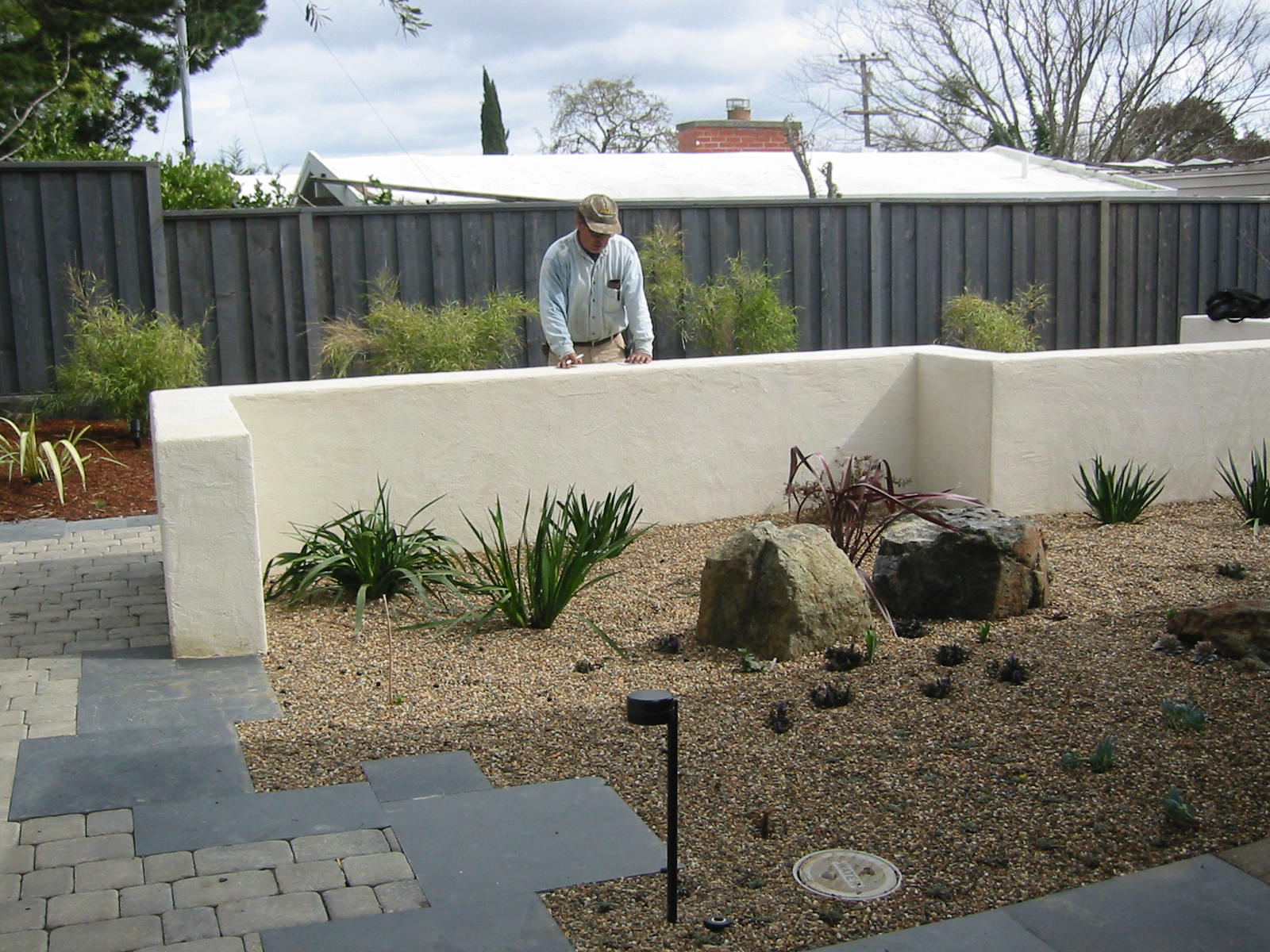
I’d be curious how you’d do that. The base rock needs to be contained as well as the DG. The above picture shows ryerson metal edging bordered by stones. You don’t even see the header. If you succeed without any edging to contain the materials, let me know
LikeLike
Dear Leslie, Thank you for all your great replies. I don’t have access to Kindle, alas, for your e-book on DG walkways and patios or I would buy it. You said you had a recommendation in Marin County for a landscaper. Would you share with me? We have a walkway alongside our driveway, with tree roots showing. We don’t want to damage the trees, at the same time we want it as safe as possible for old age, which is upon us. Should we do decomposed granite? Will road base and compacting affect the tree roots? Would permeable concrete work? I am a fellow author. Your writing is lovely. You can contact me at my email address if you’d be willing to do a phone call or a paid consultation. Katy.
LikeLike
For your tree root area, I’d do the Strybing method of 1/2-1″ DG only with base rock preparation as best you can do around the roots. Of course, it all depends upon what trees you have there. Some trees have more vigorous and shallow roots than others i.e. Liquidambers. If you look at street trees, those are picked for their deep root systems that have less chance of uprooting sidewalks. I would be leary about permeable concrete but you can ask a concrete contractor about that.
LikeLike