I’m very excited that University of Nebraska Bison Books picked up an expanded edition of Ghostwalker to be released Fall 2024. A preview of what’s new:
A new chapter exploring mountain lion management for desert bighorn sheep reintroductions in the southwest US. A highly complex and controversial issue, we look at and compare the approach of three states: New Mexico, Arizona, and California. This issue has never been addressed in depth. Mountain lions are dying unnecessarily through egregious state game agency directives.
What’s with California these days? The California chapter, completely revised, goes in depth on their problems with genetic bottlenecks in Southern California and coastal areas as far north as Santa Cruz. We’ll explore the findings of the Sonoma County study by Quinton Martins, the recent results of CDFW Justin Dellinger’s analysis, and the enormous task of building corridors and passageways for lions to continue to exist.
What’s new in the conservation scene for wildlife? I speak with Kevin Bixby about his new organization Wildlife for All. Panthera’s Veronica Yovovich tells me about their study on non-lethal methods for livestock protections.
New stories and updates throughout the book.
23 new interviews with researchers in addition to the 1st edition interviews
22 new photos
To pre-order and receive a 40% discount, use this link and enter code 6AF24
For those of you who haven’t read the first edition, I did several years of research and interviews with prominent biologists working actively with mountain lion research today. The three studies in Yellowstone National Park, a 16 year study in Grand Teton National Park, revealed the secret lives of mountain lions, their interactions with wolves, bears and other wildlife. A full chapter on California, the only state where mountain lions are fully protected from hunting; a look at mountain lions from the angle of trackers; what houndsmen who have worked with biologists have to say; along with how lions care for their young, how they find each other to mate, what a scrape is and more.
I’ll be posting short clips of many of the interviews I did with researchers in the coming months. First interview will be posted here and on YouTube in a few weeks with Sean Murphy, a biologist who worked for New Mexico Game and Fish. He’ll talk about the indiscriminate and ongoing culling of mountain lions by the department in order to transplant desert bighorns.
To pre-order and receive a 40% discount, use this link and enter code 6AF24
This is an excerpt from the upcoming expanded edition of Ghostwalker: Tracking a Mountain Lion’s Soul through Science and Story. (University of Nebraska Press, Fall 2024 release)
Just days after my arrival in California, a friend sent me a photo from a door camera of a collared lion in her neighborhood. The lion was standing in a driveway in the early morning hours. Only Dr. Quinton Martins who was running a study north of Marin was collaring cats so this lion had to be one of his. The news media quickly blew up, using the same photo as evidence. Reviewing the GPS data, Dr. Martins told the Press the young male lion known as P36 had crossed busy highway 101 five times. When the cougar encountered the crowded business area of southern Marin, he quickly hightailed it back north.
I met with Martins a few days later, curious what he’d discovered about cougars in Sonoma. Both Sonoma and Marin counties are the end of the road for cougars traveling along the North Coast, but Sonoma County has a larger suitable land base for cougars and more linkages north. Sonoma County is considered an agricultural and farming community, although in the last several decades the area has become more gentrified, with small acreage vineyards that serve as tax write-offs, mega-mansions, and commuters to points south. The semi-rural, mixed habitat region also has a ballooning number of hobby ranchers who own a few small animals like goats and sheep.
Martins measures a mountain lion’s tail after a capture
From South Africa, Martins was an experienced safari guide with a particular interest in leopards and lions. He became intrigued with the mountain leopards of the Cape in South Africa and began a 10-year research study which contributed to his PhD, learning more about this elusive mountain cat and inventing innovative ways to trap and collar them. In 2016, Martins introduced a mountain lion project to Audubon Canyon Ranch, a local and established San Francisco North Bay environmental non-profit. The proposal was accepted and called Living with Lions Project.
I ask Martins to describe P36’s journey. Martins shows me a map with P36’s GPS pings on them. It looks like a drawing of a billiard game with dots everywhere, some clustered, others far-flung. P36 hadn’t just arrived south into Marin, but previously roamed through three counties looking for a territory to call his own, at one-point landing in a parking lot by the ocean
P5. A male in Martins study
“Ah, so that’s the Pacific. Always wanted to see that,” Martins jokes. “Then P36 heads down the coast all the way to Point Reyes, ending up overlooking the Golden Gate bridge. Back tracks and pops over to Tiburon. The last GPS reading indicates he’s hightailed it out of Marin and crossed the Russian River heading back north through Sonoma County.”
So far P36 has been lucky, crossing busy highway 101 several times without injury. He explored three counties of suitable habitat, all probably occupied by resident males. Like the findings in Santa Cruz, Martins says these young dispersers seem to use sub-optimal fringe habitat while they move about, staying under the radar of any resident males. Dispersers typically use creeks as corridors, killing small prey like raccoons as they navigate to a permanent territory. Habitat near human dominated areas is rich with small prey that cougars can live on.
Releasing a cougar from Martins capture set
“P36, his diet has been amazing,” Martins tells me. “We recorded him since March last year killing 37 deer, 6 wild boar, 2 badgers, an otter and a squirrel. No livestock. And we’ve had him on properties where there is livestock around like calves and he’s made a deer kill right there. You get a day bed reading where he’s walked back through the livestock area, hangs out there, then goes back to feed on the deer he’s killed.”
Given that the North Coast region is still considered an excellent source of genetic diversity, I was curious about the success of Martins’ male dispersers. P36 was doing well, but what about his other cats. Martins shows me a map of his eastern Sonoma study region where two males have successful territories. Considering the majority of suitable habitat in the area is likely already occupied, dispersing males are going to have to head north into Mendocino or beyond.
“There is clearly connectivity in our landscape, which means that any cat can come down here, or get out of here. The key source areas are really important; then ensuring connectivity in the landscape is the next thing. We’ve got all that (in Sonoma County). We’ve got great source populations up north, from Oregon, Mendocino. But cats coming south get to the end of the road in the North Bay area.”
Coming soon, audio link to listen to Dr. Quinton Martins talk about his unique system of mountain lion capture
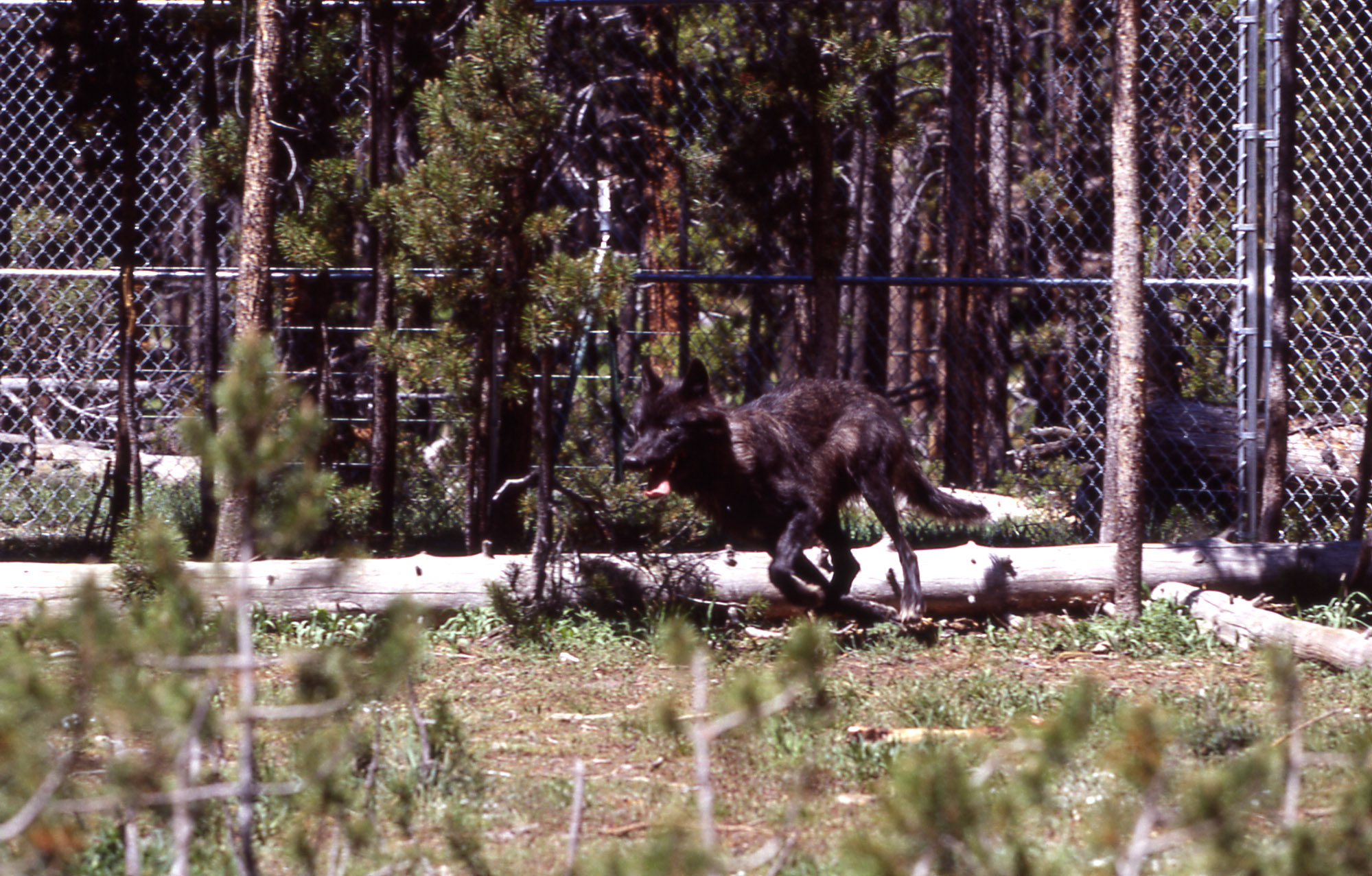
In 1996 I was invited to stay overnight at the Nez Perce Patrol cabin in Yellowstone National Park. In the early dawn, I took a walk to the end of the service road. As I peered through the trees, what I saw startled me. In a large clearing was a wolf reintroduction pen. Ten wolves were running around the inside perimeter of the pen. I could hear their heavy breathing. I stood and watched in awe. That intimate moment was my first wolf sighting. Little did I know the magic of that chance encounter would change the trajectory of my life.
Wolf in the Nez Perce pen summer 1996 (NPS photo)
Almost simultaneously, in another part of Yellowstone, several young wolves, pups from the previous year’s reintroduction, were becoming restless. A black female yearling from the newly formed Druid Pack, along with a male from the Rose Creek pack, dispersed to form one of the first packs east of the Park. These wolves may have been following elk that migrate outside the Park in the winter.
Eight years later, I purchased a run-down sixty-year-old log cabin in that same valley where descendants of those young dispersers now lived. That spring was the first extended stay at my new cabin.
Spring weather can be changeable and blustery. Creeks can swell and suddenly the road you traveled on in the morning is impassable upon your return. I decided on a hike up a beautiful drainage surrounded by sandstone cliffs. I didn’t know wolves were denning far up. Alone, I wondered how I’d feel if I encountered a wolf up close. I thought to myself, “I’d be afraid.” On my descent back to the car, a strange hollow sound caught my attention on the adjacent hillside. I found myself within twenty feet of a black wolf. We shared a long moment, then the wolf trotted off. I felt no fear, only an unusual sense of recognition.
We shared a moment
I slowly remodeled my cabin and, in the winter of 2008, I moved full time to my new home. The winter snow revealed the wolves were using dirt roads as an easy corridor. Hearing wolves howl at night was not that uncommon. Encountering wolves on hikes, or watching them feed on kills from the road was a regular occurrence. Golden eagles, ravens, and bald eagles circled and also fed on the carcasses. The valley was alive, not just with wolves, but their presence introduced an electric force that stimulated all the wildlife.
Coyotes taking advantage of a wolf kill in the valleyBald eagle and ravens wait around a carcass left by wolves in my valley
Then delisting arrived in 2012 with a hunt. It was erratic at first with relisting for several years, then a permanent unchallenged delisting in 2016. Wyoming has decided that my area is good wolf hunting and sets a large quota. Wolves know humans now. They are secretive, travel mostly at night, and are skittish as if they have PTSD. Wolves are adapted to fighting for territory. They lose pack members to other wolves. But humans are an unpredictable agent that unravels packs.
The Lamar pack in my valley after 06 was shot in the first Wyoming hunt in 2012
The valley in winter has become quiet. I no longer hear wolves. I haven’t seen ravens circling or golden eagles feeding on wolf kills for many years. Wolf tracks are now a rarity. My winters are lonelier. The wind howls, but there is a deafening silence without the wolves’ presence. The intensity of the dance of Life they brought passed like a great storm. An untold loss happened with the hunt.
State game agencies look at a hunt as the natural progression to delisting, yet they discount the havoc it brings to wildlife systems. I wouldn’t have seen this directly without living through the policy change. Yes, there are wolves still here, but they are not acting naturally, and their pack families are continuously broken and destroyed year after year.Wolves travel only at night now, trying to avoid hunters.
A lot of attention is paid to wolves in Yellowstone Park. There was a passionate human howl when hunt quotas were increased along the Park’s northern boundary because it would disrupt Yellowstone packs. I understand that. But studies are needed on the impact of continuous hunting to wolf packs, and what happens to an ecosystem when they are heavily pursued.
Wyoming Game and Fish calls trophy hunting “opportunity.” Because of road access, my hunt zone has better wolf hunting “opportunity.” Yet compared to elk and deer hunters, few people hunt wolves. Those few have stolen my opportunity to see and hear wolves. Places like where I live, with abundant National Forest and Wilderness, do not need wolf hunts.
There is a term in wildlife tracking called baseline. That means an animal is traveling at its natural, most comfortable gait. Weasels lope, bears walk, wolves trot. For me, that is a metaphor of the natural rhythm wolves should be able to live without humans stealing their birthright.
I recently watched an excellent zoom presentation by Dan MacNulty entitled “New insights into the ecological effects of wolves in Yellowstone National Park.” MacNulty is a professor at Utah State University who has done extensive work in Yellowstone since 1995 on the effect predators have on the ecosystem. MacNulty presented an historical view of wolves and elk in Yellowstone, concentrating particularly on the effect wolves have had on elk and on aspen growth. The two summary take-aways are that:
1.a whole suite of predators (wolves, bears, cougars, and humans) have affected elk in the Northern Range (the study is inside and outside the northern border of the Park as elk migrate with the seasons), and that
2. wolves really have not had a significant trophic cascade effect on aspen (i.e. elk were pushed by wolves so that they were no longer over-browsing aspen sometimes called the Landscape of Fear) that these previous studies suggested. MacNulty did a long-term extensive study on a variety of aspen plots inside the Park which showed the Landscape of Fear theory did not hold up.
Mature old aspens with young regeneration saplings behind
Much of the zoom presentation material wasn’t new, but several things caught my attention. A chart MacNulty presented showed that wolves take older elk, those aging out of fertility. (Chart screen capture below). He presented another chart showing that hunters tend to take younger aged female elk, the most reproductively fertile in a herd (screen capture not shown). Add that to calf predation which is mostly by black and grizzly bears, followed by wolves, coyotes, and cougars, and you have an all-age class predation by all predators (humans included). One other chart MacNulty showed was that if we eliminated the hunt on cow elk, the Northern Range population would rise to around 11,000-12,000, about double what it is now.
But what interested me was MacNulty’s comments on how elk are not disturbed by wolves unless they are actually hunting. Arthur Middleton’s study on the two Cody herds also showed the same information. Interns spent countless hours observing elk feeding. Middleton’s conclusions were that elk showed no concern for wolves unless they were within about 1/2 mile. Middleton also told me that he spent time observing elk calmly grazing on a hillside in front of an active wolf den.
When the idea of a Landscape of Fear came out several years ago, it never sat right with me. Certainly elk have changed their habits since wolves appeared, their age-old predator. Elk in Colorado for instance, where no wolves exist, will chomp on grass on golf courses, hang around roads, and show no concern. Why should they? They have become like cattle, unhinged from their natural wild instincts. Yet here in the Yellowstone ecosystem, having now adjusted to wolves returning (along with cougars and grizzlies) doesn’t mean elk are now living in a state of fear.
To me, the idea of a Landscape of Fear applies to us humans who rarely enter into an ecosystem where we are not the top predator. We take a walk or hike in grizzly country, thinking all the while there is a bear behind every bush. Or in cougar country where we have a gnawing fear for our lives. We are visitors and have no real knowledge of the habits of what would be our neighbors if we lived in daily contact with them. For wildlife, the natural world IS their home and they know their territories very well. Even migratory herds, like elk and deer, are not only following eons-old routes, but they are faithful to them. They know the habits of their animal neighbors and are well aware of the wildlife that are nearby at any time. Wildlife do not live in constant fear; they live in an Awareness of their surroundings.
Living in fear is not a useful emotion, for humans nor for wildlife. Living with Awareness is. So when MacNulty said their findings did not suggest elk were triggered by wolves (except of course when they are actively hunting them), this made sense. And then it would follow that aspen recruitment isn’t especially affected; that there are many other factors at work relative to aspen regeneration.
One very interesting comment by MacNulty was that was mountain lions, not wolves, changed elk behavior. MacNulty didn’t go into this much further. I certainly would like to hear more about this, but my guess, based on speaking with Dr. Toni Ruth for my book Ghostwalker, is that cougars of course are ambush predators and are quite competent of killing an elk wandering off into the trees. It is more risky and difficult for cougars to take down an elk in the open where elk have the advantage.
I just want to end on another note. The short youtube video called How Wolves Change Rivers went viral many years ago. Although wolves don’t change rivers nor especially help regenerate aspen, I don’t object or fault this story. Humans are storytellers and story driven. False stories like the wolves that were reintroduced are non-native Canadian wolves motivated an entire group of wolf-haters to believe and spread that narrative. On the other hand, wolves changing rivers and enhancing wildlife is a positive story that stirs our appreciation for wolves. Good stories will help foster an appreciation for wolves and other predators.
If you want to listen to a recording of the meeting, it was hosted by Western Wildlife Conservancy and look for the passcode and link
Three Hoodoo wolves. This pack is now gone after last year’s hunt
I was encouraged by The Sierra Club to write an op-ed on the dramatic changes I’ve experienced in my valley since the delisting and hunting of wolves here in Wyoming. With their help, the op-ed came out in The Salt Lake City Tribune.
The original op-ed was a longer more expressive piece which needed to be cut for the Tribune’s size qualification. I thought I’d print that here.
ONE day in late spring when the light is low and dusk lingers for hours, I headed out for a short hike in a series of craggy volcanic contours of hills and narrow arroyos. Some of these gullies hold snow melt run-off for weeks, attracting bears and cougars. Following a narrow animal trail over slippery scree slopes, I slid into a tight channel with a trickle of water running through it to inspect for tracks. As I headed back up the incline to the makeshift trail, a wolf came trotting by. We saw each other simultaneously, less than ten feet apart. I relished the moment, but she didn’t. Startled, she jolted, eyed me for less than a moment, then darted off. This was two years ago and my last close wolf encounter. Although these close encounters are vivid in my memory, my multi-year observations of the impacts wolves had on my valley is the story I cherish most.
I was lucky. I bought a home in a remote valley next to Yellowstone in 2005, less than nine years after the Yellowstone wolf reintroduction. Wolves had been in the valley for a few years, managed by the U.S. Fish & Wildlife Service and protected from hunting. Elk descend from the high country starting in December, and the wolves follow the elk. My first resolution was to wake up at dawn at least five days a week during January through March and observe elk, with the hopes of also seeing wolves.
Our coyotes were still learning about living with wolves, many times to their demise. With less coyotes, foxes were making a comeback. Locals told me they hadn’t seen foxes in years. I saw them frequently now. By watching winter bird activity like ravens and magpies, I could find kills. Golden eagles were always there, and surprisingly, bald eagles as well, who winter at lower elevations. The winter landscape was alive and tracking became a favorite activity of mine. Several times I tracked mountain lions to a kill site, only to see where wolves had taken over the cat’s kill. And of course, what a thrill to hear a wolf howl. February, the mating month, I heard wolves howling during the day as well as the early mornings. I saw blood trails during their estrus and my dog sometimes found cached meat under the snow.
At one point, after Idaho and Montana began their wolf hunts in 2009, our area had the highest number of wolves in the Northern Range, over 40 in several packs. I watched as these packs vied for territory, keeping their numbers in check to accommodate for territory and prey. I learned then that wolves self-regulate themselves.
During the spring and summer, when wolves left their pups at rendezvous sites, it wasn’t uncommon to encounter a lone wolf on a hike. I had made sure to have my dog well-trained so he never ran after wildlife, especially wolves. Our valley was alive, and slowly our elk herd was learning how to manage with the return of their ancient predator.
In 2012, the Feds delisted wolves in Wyoming, giving the state jurisdiction. First thing Wyoming did was to begin a hunt which lasted only two years until a Federal judge relisted them. But within those two years wolves developed a fearful relationship with humans. Before that time, watching a wolf pack from the dirt road in a vehicle didn’t bother them; encountering one on a hike, they’d observe you then run away. I never felt threatened by wolves. They are curious by nature, and like most animals, don’t want to have much to do with our species. Yet just a year after that first hunt, if they heard a car coming a mile away in the silent depth of a winter morning, they’d disappear.
From 2014 to 2016, wolves in Wyoming were back on the Endangered Species List. It was an odd interval because even though the Feds now had jurisdiction, they had not planned nor allocated extra resources for this turn of events. During the summer I ran into the USFWS biologist monitoring wolves. He asked me to let him know if I saw any wolves, especially pups. Few wolves were collared and no collaring was going on. The wolves had a short reprieve.
Then in 2017 our wolves were delisted again. Wyoming Game & Fish has decided my hunt zone, adjacent to the Park, is easier for wolf hunting opportunity because of backcountry access. That translates into the highest quotas in the Trophy Management Zone. I’ve asked why we have more harvest success here than other zones. I’m told by game managers that wolf hunters are now coming here just to kill wolves; and there are outfitters specializing in providing that killing opportunity.
With five consecutive years of hunting, I no longer see wolves nor hear them. Our winter nights are strangely silent. Sometimes I catch a few on my trail camera near my house. They always travel at night. There’s no need to look for ravens circling or golden eagles in the winter. Although our recent winters have been mild, dispersing our elk, other friends who hike confirm it’s rare to find kill sites anymore.
One of our wolf pack travels back and forth into the Park with the potential to supply fresh genetics. Last year they did not breed nor did our other main pack. Both were reduced, according to the 2020 report by Wyoming Game & Fish, to just three individuals. This year I was told that same pack was all but wiped out, a pack that has been our stronghold since I arrived in 2005.
Wyoming Game & Fish’s idea of managing wolves is hunting opportunity. But what about my opportunity? The opportunity to hear the primal howl of wolves, to observe them, and to witness all the amazing changes—changes that resulted in a landscape teeming with life. Without the natural play of all the varied wildlife, my valley, like so much of the lower 48, is a bereft landscape.
I am lucky. I’ve had so many unique wildlife encounters, memories I’ll cherish forever. I’d like my children and grandchildren to have those same opportunities. But until state wildlife agencies change their orientation, a posture that considers only hunting opportunity, disregarding ecosystem health and wildlife viewing opportunity, things won’t change. I’m using my sorrow and anger to express what we who cherish our wild lands and wildlife must do–speak up and press for change in state wildlife management outside our National Parks. Perhaps that means relisting wolves and revamping the parameters upon which jurisdiction can be given back to the states. If so, then that’s what must happen.
Until then, I’ll remember those rare and powerful moments I was privileged to experience. One evening while returning home at dusk, three wolves ran across the highway in front of my car. Beginning their night’s hunt, I was struck by their excitement, their intensity and force. They seemed the very embodiment of the immense and wondrous power that is the Universe itself.
Life can be suppressed, but it cannot be crushed. Wolves, in their ceaseless energy, their deep intelligence, epitomize the purity and dynamism of Life itself.
I recently did a webinar for The Mountain Lion Foundation on the complex issue of bighorn sheep management and mountain lions with a focus on the Southwest United States. Routinely, mountain ranges are cleared of mountain lions for relocation of bighorns, and then predator management is continued in those areas with either increased hunt quotas or agency-paid contractors to protect these small bighorn herds.
It’s a complex subject because bighorns are under continual stress due to diseases from domestic sheep and goats, never able to get a leg up to build a healthy herd. Although bighorns are subject to many diseases, the major respiratory disease, Mycoplasma ovipneumoniae (MOVI), is the ringleader. MOVI weakens the bighorn’s immune system, making them vulnerable to a host of diseases and stressors. Unlike the herd in the Absaroka mountains of Northwest Wyoming where I live that has a metapopulation of over 4000 bighorns in a contiguous protected landscape, desert bighorns live in small herds, on isolated ranges, where connective corridors have been disrupted by domestic animals, roads, and housing developments. Small herds, with weakened genetics, are especially vulnerable to mass die-offs due to MOVI.
Last year I conducted a series of interviews with biologists and agencies and made a trip to Arizona and New Mexico to dig deeper into this issue. Bighorns need our help, but killing lions continuously cannot be the answer. While disease is the lynchpin issue with bighorns, other factors contribute to weakening them, including water, genetic diversity, how to establish metapopulation connectivity, degraded habitat, and of course climate change.
In my latest book, Shadow Landscape, I include an essay that explores these issues and what might be done to help bighorns that would also protect mountain lions. You can read that essay for free on my website blog site. You can also watch the webinar on youtube.
The issue is complex and I encourage everyone who cares about wildlife, bighorns and mountain lions, to watch the webinar and/or read my essay.
Yesterday I hiked to one of my trail camera sites planning on retiring the camera for the summer. Because our deer and elk migrate into the high country around Yellowstone starting in May, there is little action with large predators. Grizzly bears start to disappear around early July. On the east side of Yellowstone in the high elevation cirques of the Absarokas, moth sites feed the bears. Cougars are following our deer which make one of the longest migrations in the ecosystem. Wolves probably completed denning and will be taking their pups to rendezvous sites with a babysitter or two, while the other adults forage for food.
Cougar print at 10,000 feet early June in the Beartooths. Lions are following the migrating elk
So you can imagine my surprise when I looked at my camera videos. My newest male cougar is still hanging around, marking his territory with scrapes. He appears to have beat off another large male that has one eye, the other probably lost in a fight. One-eye was last seen at the end of March.
New male in the area. Notice he has eyeshine in both eyes, distinguishing him from One-Eye
Even more exciting, I caught a mating pair of grizzlies. By the time of the year, and the fact that these are two adults, you can be sure this video is a male following a female in estrus.
Large male grizzly. See video link for full story
In summer, when grizzlies disperse for high elevations, the black bears take over. Male black bears will make sure to display who is boss by tree rubbing, destroying cameras, and stomping which also puts down their scent. Interestingly, grizzlies know they are the real top of the food chain and could care less about cameras, although they do rub trees, both males and females. Here is a video of a grizzly female with two cubs spending time tree marking with her cubs following suit.
Mama Grizzly. See video link for story
On a very interesting note, I camera-captured two blonde animals this spring—a fox and a black bear—both fairly rare. To understand this in greater depth, I contacted Jim Halfpenny, well-known mammalogist and tracker. Jim told me he had never seen a fox this blonde, whether at fur sales or in the field. He thought maybe this fox could be a fur farm escapee, but in my inquiries we haven’t had a fox farm in the Big Horn Basin since 1996, plus I live in the high mountains next to Yellowstone so the mystery continues. In addition I’ve never had a fox show up at this location before. This little blonde red fox continued to visit this site over the course of several months, which adds to the mystery.
Blonde phase Red Fox. See the entire video via link above
The blonde phase black bear is also unusual around these parts. Halfpenny told me he had only seen one briefly around the Greater Yellowstone Ecosystem, and never as blonde as this one. Color phases of black bears are not unusual, but the blonde phase is the rarest. Here is a link to an interesting breakdown of color phases of black bears in North America. Although it is presented by a hunter, it is informative. I do NOT support any trophy hunting, but I encourage you to watch this for information. No actual hunting is in the video.
A large carnivore biologist who I showed the videos to had an interesting thought. “Wonder if this is a genetic expression due to the initiation of climate change,” he wrote me. Thinking outside the box leads to interesting possibilities.
Blonde phase Black Bear. See video via link above
Finally, my new book Shadow Landscape is now available on Amazon. These are stories of wildlife encounters I’ve wanted to tell for a long time. I appreciate all my readers and followers. Thanks for your interest in our iconic wildlife.
My new book, Shadow Landscape: Stories from the Field will soon be at the presses. In Shadow Landscape I relate personal stories of wildlife encounters, some intentional and other serendipitous. Below is a summary of each story for your reading pleasure.
Part I – One fall I had an unusual visitor at my home. A Pika Visits chronicles my month living with a pika at 6300 feet.
Two of the stories come from when I lived in the Bay Area: Gil and the Bees and The World of Fungi. As many might know, my background is in plants, but I also kept bees. Gil and the Bees relates many trials and errors of novice beekeeping, and the amazing affect going into a hive has on one’s consciousness.
The World of Fungi is a weekend adventure I spent with two avid and intense mushroomers who sold their collections to high-end restaurants in San Francisco. Mushrooming is a unique hobby and very competitive. The story takes place in Mendocino County on the coast.
In Dickinson Park I leave the reader to answer the question what animal it was I heard screaming through lonely forests in an area that had been off-limits to humans for over a year.
Wild Cats is a series of three personal stories about the cats which live in my ecosystem: cougars, lynx and bobcats.
During the final season of my dog Koda’s life (see Koda and the Wolves for his full story) I took him daily to a nearby hidden pond to swim. The remote area had a lot of wildlife. I kept a diary of the events.
In Part II, I tell stories that gave me insight into our current wildlife management institutions and my thoughts for future constructive change.
Wolves in the Crosshairs are two stories of wolf incidents. In the second, I ask the question: what is the objective of wildlife monitoring (other than concrete scientific studies with goals) and are we moving towards wildlife husbandry with so much technology.
Wyoming Game and Fish wolf collaring
For those who want to recreate in grizzly country, for those who want to escape urban life and move to grizzly occupied and corridor areas, I press in Grizzlies in a Windowless Room that the cautious advice isn’t to carry bear spray. The cautious advice is that we all must endeavor to preserve habitat and tolerance for the last of our grizzlies. The story feeds through a grizzly mom with three small cubs personal encounter into the arduous year that a grizzly hunt was almost enacted.
The year I learned that out of state hunters can raise dollars to pay a government agency to kill coyotes in specified areas in a state far from their own. Many of us are familiar with Wildlife Services killing coyotes for ranchers, but in this story they kill coyotes for hunters, where even the regional manager for Wildlife Services says it makes no sense and will have no affect. Coyote: The Fall Guy is about that resilient yet so persecuted animal that is the scapegoat for many of our troubles.
Bighorn’s Gordian Knot is the longest essay. In it I delve into the complex reasons why our native bighorn sheep are continually on the edge of die-off and why mountain lions are not the issue. That story in particular contains an example of how wildlife agencies can adapt, listen to a wide range of public opinion (not just hunters), and allow diverse working groups to drive effective policy.
The connection between all these tales is my own clumsy attempt to touch nature’s heart, to understand the ineffable, to reach beyond my grasp and dance the complex dance where nature is the invisible, and shadow, instructor.
Several years ago a friend suggested I write a book of stories and essays centered around wildlife. The slow pace of life during the last year allowed me time to consider which stories I wanted to flush out and include, as well as the theme of the book. The final product is my new book Shadow Landscape: Stories from the Field.
All the stories are personal experiences, a few from my time living in the Bay Area, some from travels in the Southwest, with the bulk of the tales coming from my home around Yellowstone.
The shadow in Shadow Landscape refers to the life around us that we normally are not tuned into and have little to no integral part of—that is of course, the dance of wildlife. Here is an excerpt from the Preface describing what you can expect when you buy the book.
Soon to be released
Working for many years with plants and animals, I now consider the animal world like a troupe of jazz dancers. Wildlife sway and move to each other. They anticipate their partner’s next maneuver; they are creative in their calculations and read with expertise every gesture, smell, and sign on the land. Meanwhile, we humans sit on the dance-floor bench with only the two-step under our belt. We are bumbling and awkward in our participation. Loud, fast, self-absorbed. Possibly the connection between all these tales is my own clumsy attempt to touch nature’s heart, to understand the ineffable, to reach beyond my grasp and feel like I too am learning to jazz dance.
Two of the stories in the first section, Gil and the Bees and The World of Fungi, come from my time living in the Bay Area. Of course, we can connect with the beauty and wonder around us even in our backyards. As a child, my love of nature began by wandering my Los Angeles backyard counting bird nests every spring and admiring the differences in their eggs. Most of the other essays take place from my home in Wyoming, where some of the last large animals in North America have room to roam.
End of the Wild, section two, concentrates on human interference and our bumbling, as opposed to our wonder. Each story, from Wolves in the Crosshairs to Killing Coyotes to Grow Deer tells a personal experience of human intrusion into the natural daily lives of wild animals. Every incident directly and personally educated me as to how far humans are willing to go to dominant the landscape. Bighorn’s Gordian Knot centers around a thorny issue I became aware of when writing Ghostwalker. Mountain lions, particularly in the southwest United States, were being cleared off mountain ranges in order to reintroduce bighorn sheep. The issue is complicated since bighorn sheep were on the brink of winking out. In this essay, I delve deeply into the bighorn’s multitude of issues, why mountain lions are not a major factor, and what a step forward might be.
In Part II I ask the questions: how will we protect our wildlife into the future? What is our relationship to wildness? What are we losing when we lose wild nature and what do wildlife need to go about their business sans our awkward dance?
Shadow Landscape contains six stories in Part I—The Shadow Landscape, and four stories in Part II—End of the Wild.
I expect the book to be released within the next few months. I will have more information for you soon, including price, page length, and I’ll share the table of contents with some excerpts. Book price has not been set, but I am planning on a deep discount when you buy a copy directly through my website. Buying through my website entitles you to a signed copy. Books will also be available through Amazon and your local bookstore.
Humans are story-driven. We are visual creatures and imagination drives us to act. For those reasons, I feel we need new and better stories that press on us to conserve wilderness and wildlife for future generations. That is my hope in writing Shadow Landscape.
Disease, domestic sheep proximity, habitat degradation, human encroachment, water construction, predation—all part of the tangled web of problems for bighorns. But there are still other pressing problems for these animals that may have deeper consequences.
A big stumbling block biologists are facing is connectivity. Sky Islands and basin/range topography are comprised of isolated islands of habitat. Minimal population size for healthy genetic diversity seems to be around 200 animals to ward off most stressors. Historically, desert bighorns existed as metapopulations, large areas of basin/range where bighorns could roam and connect freely. A bighorn population wasn’t just one mountain top, but a wide swath of desert and mountains containing sub-populations inside of metapopulations. Harley Shaw commented to me that in looking at the history of desert bighorns in the Southwest, his view was that historically mountain ranges with these small populations were constantly winking out. Roaming instincts would push a few bighorns across desert floors to repopulate new ranges. Today that’s a near impossibility.
The entire state of Nevada alone was once considered one large population of bighorn sheep. “Moisture is so spotty, and we have so many rain shadows,” Mike Cox from Nevada Department of Wildlife relates, “that bighorns were very nomadic. They would chase green-up.”
I asked Cox about connectivity today . “It’s pretty sad, especially in Clark County which is the county of Las Vegas. We have islands, these sky islands of bighorn sheep that can’t go anywhere. They can’t roam. They can’t go on forays or they’ll get killed on 6 or 8 lane highways.”
Along with roads and barriers, there is the issue of a roaming bighorns coming into contact with domestic livestock and disease. Without a viable solution, many wildlife agencies resort to periodic infusions of additional bighorns on a mountain. With new knowledge of disease strains, even that has its limitations. Amber Munig with AZGF told me the agency was looking at boosting a bighorn population southwest of the Colorado River. They tested both herds and although both have titers for Mycoplasma ovipneumoniae, the strains were different so they cancelled the translocation.
“Our translocation program is slower now because we don’t have as many areas to put them into and we’re very cautious about moving pathogens from one population to another,” Munig says. “We’re mostly supplementing existing populations at this point in time to ensure the genetics is still there and that becomes a concern when you have fragmentation, especially with roads that don’t allow them to cross between mountain ranges.”
Mike Cox is looking towards another answer. Some of the new research points to chronic asymptomatic disease shedders as the reason why a herd just cannot recover. The newest push is to find these shedders and kill them, called “test and remove.” Experiments in Oregon’s Hells Canyon by researcher Francis Cassirer shows promising results with a natural fade-out of the disease over time when carriers were removed in connected populations. But, as Cox points out to me again, “just because one bighorn gets one Mycoplasma strain doesn’t mean the next strain that comes along won’t be worse. There is no immunity that’s generated from one to the other.”
Hells Canyon Test and Remove update 2020. Presentation WSWG Disease Mgmt Venture by Francis Cassirer
Jessica Moreno with the Coalition for Sonoran Desert Protection looks to wildlife linkages as a viable solution for healthy wildlife. Focusing mainly on Pima County around the Greater Tucson area, the Coalition partnered with Arizona Department of Transportation and others to plan a wildlife crossing. The crossing, one under and another over State Route 77, were installed simultaneous with the final bighorn translocation into the Catalinas in 2016. This first of several planned crossings connects the Catalinas to the Tortolita mountains. The next crossing is planned for Interstate 10, a more challenging endeavor, that would continue the wildlife passage from the Tortolitas to the Tucsons, the Silverbells, and through Saguaro National Park West into open desert country and Tohono O’odham Nation Reservation.
Moreno’s viewpoint is that bighorns face a tangled web of stressors, and many we might not even understand or recognize as stressors. But if we look at the bigger picture, giving the bighorns roam to connect, even if one population crashes, more bighorn sheep will come in to boost the population.
“By taking that landscape approach, you allow the animals the freedom to respond to stressors on their own, leaving that option available so they can respond to fire, disease or climate change. Their populations can crash but then rebound the way they need to. I like that about the work I’m doing to establish wildlife corridors and build wildlife crossings as it reaches across different species and gives a little bit more resilience to those populations that are dealing with different pressures.”
So far, with trail cameras placed in the area, State Route 77 crossing hasn’t produced any bighorn sheep using it over the last four years. But it still can be considered successful, with over 5,000 mule deer using it, along with javelinas, bobcats, coyotes, and lots of smaller species. But crossings elsewhere have been successful for bighorns. Wildlife crossings installed between Kingman and the Nevada state line on U.S. 93 between 2007 and 2011 documented use in the first four years by over 6.000 bighorns. Given the complexity of disease issues, it’s hard to know if these kinds of connections might solve the fresh genetic flow yet doom a population to new strains of disease.
The biggest unknown of all is our rapidly changing climate. Connective corridors undoubtedly help facilitate movement, allowing wildlife to adjust to habitat changes and water availability as their environment heats up. The totality of all the issues affecting bighorn sheep in particular is complicated and nuanced. Connective corridors might solve one piece of their Gordian knot but certainly not all.
____________
I made a pie chart of all the desert bighorn sheep stressors I’ve learned about
I grab my snowshoes, prepare a few snacks, and head up to a high mesa locals call Little Bald Ridge. In deep snow it’s difficult to follow the spines of the lower ravines that lead to the mountain top and the animal trail that hugs the hillside higher up would be obscured. But we’ve had little snow this winter and today with a clear sky, a light wind, and temperatures in the teens, it should only take an hour to climb to the wide butte.
I’m hoping to see our little band of Rocky Mountain Bighorn Sheep. They like the wind-swept meadows and craggy overlooks. The elk covet the area too, though the two species never group up. Wolves might be there, but their interest is in the scent of the elk, not the bighorns.
The final ascent leaves me a bit winded. The trees have disappeared. I always have to remember to watch for a large sinkhole beside the animal trail, which the trail swings directly alongside. The elk have trodden down the snow by its edges, but the hole is steep and deep and makes me nervous. I climb the last few hundred yards to the meadow expanse. The ground is cropped clean from the large elk herds who take advantage of this high windy spot that sweeps the snow clear. Even the sagebrush is just bare stems. As I clear the rise, I spot the bighorns. A small herd of ewes and lambs clasp the rocky cliff edges along the eastern rim. The meadows stretch to the west in a large expanse. Picking up my binoculars, I see a mixed age group of rams grazing in a hollow below.
I’ve been here before in winter without seeing bighorns or elk. The wind is usually in a howl, which highlights those moments of deep terrestrial loneliness. Without the bighorns, this top-of-the-world is not right. It’s definitely special to see the bighorns here today. Even so, these small groupings evoke both elation and sadness. I know that on these same ridges just a few hundred years ago, the native peoples who lived in these mountains watched herds of hundreds, perhaps thousands, of bighorns. These ones today are the hanger-oners, the bighorn sheep that survived the onslaught of white men and their livestock diseases. They are the toughest, yet they eye me with sweet docility, unafraid of my presence. I sit down a few hundred yards away and enjoy. Soon they pay me no mind, and go about their browsing business.
Bighorn sheep appear tough because of the rugged places they live, yet in reality they are soft creatures, whether we are speaking of their animal nature or their constitution. Just being with them I feel softer. I’d like my grandchildren to be able to experience their soft-tough nature. The fact that their presence on this planet coincides with ours implies we must care about their plight, not let it extinguish. That forces us to answer difficult ethical and moral questions. First, there is the money that supports these herculean efforts to help bighorns. Where does it come from? We’re talking about millions of dollars. All the western Fish and Game Agency bighorn sheep programs obtain one-quarter of their revenues from bighorn hunting licenses sold to the general public. The other three-quarters comes from Governor’s auctions and raffles. Kevin Hurley of the Wild Sheep Foundation gives me an example.
“In South Dakota, by statute, there are only two bighorn sheep licenses and they are resident only. That generates $550 a year in revenue. The first year they had [a governor’s tag], it sold for $102,000, and 100% of it went back to South Dakota Game, Fish and Parks. So for $102,000 think what can you do for bighorn sheep versus $550.”
Very few bighorn hunting tags are sold per state every year. The situation with bighorns is just too precarious. What supports bighorn sheep programs are these tags that are up for bid at auctions, bought by the super wealthy. For instance, Rick Smith, a retired telecommunications executive from Dallas, was the highest bidder in New Mexico’s auction and won seven tags over eight consecutive years to hunt bighorn sheep. He spent over $1 million dollars on those tags, 90% of which goes directly to New Mexico Game and Fish’s bighorn sheep enhancement program.
A skylining bighorn ewe
If we value bighorn sheep then there needs to be a way to fund programs that support bighorns other than through hunts and super tags. There is something obscene in the sole financial support to save bighorns throughout the West—native wildlife which are in the public trust—relying on a sliver of mega-rich trophy hunters. Additionally, being dependent exclusively on hunters for bighorn dollars creates a vicious cycle that pressures agencies to put more bighorns on every mountain so as to increase revenue. It also fuels extreme predator management programs like in New Mexico, where the culling of lions never ends despite bighorn herds that are thriving.
Funding is only one aspect. I think we have to be honest—the intensity of life-support programs that especially desert bighorn sheep need may soon be beyond justification. We need to ask ourselves the hard questions. Can we continue to transport water, not only because of the price tag, but as water itself becomes more precious in a thirsty Southwest, will the program even be sustainable. With the extreme drought conditions of 2020, Arizona hauled close to one million gallons of water, some even by helicopter.
Mycoplasma ovipneumoniae is here for the long run. Researchers are still puzzled how to control it and how to deal with emerging new strains. If we support separation of bighorns from domestic sheep and goats, are we willing to boycott wool from Western growers? Or to contribute cash to buy out wool growers and their public lands grazing allotments? While Bighorn Sheep NGO’s have already been actively raising dollars to help retire grazing allotments, isn’t this the responsibility of all Americans? Again, wildlife are in the public trust, therefor all of our responsibility.
It’s obviously absurd and expensive to keep plopping new bighorn sheep recruits into mountain ranges to enhance their gene flow. Should we instead adopt the “test and remove” program, where shedders are identified and culled? Do we give this kind of program a cut-off limit?
There is a point sometime in the future where we’ll have to cut bighorns loose. Yet we do have an obligation to the bighorns to do our best for them, to right so many of the wrongs they’ve suffered from our misdeeds. In my mind, perhaps our best is displayed in places like the Desert National Wildlife Refuge in Nevada or San Andres National Wildlife Refuge—immense tracts of mountain ranges surrounded by even larger tracts of wild areas completely off-limits to the public and livestock. Allow the bighorn populations to fluctuate naturally.
Instead of trying to fill every historically occupied mountain with bighorn sheep, we should consider a sub-population model, where suitable habitat can provide the bighorn sheep natural connective corridors to other nearby ranges. Land might need to be purchased to enlarge the protected area and grazing allotments retired. Initial habitat restoration would be completed, then we’d just let bighorns be bighorns, and lions be lions. This would be asking a lot of the general public; we all need to step up, not just hunters and the super-rich who can buy tags. An egalitarian effort is needed; an extreme push, perhaps a sprint rather than a marathon. For the bighorns sake, it’s time to decide if we are all willing to rise up to the task this implies—guardians of the ancient way of life of the bighorn sheep. At the very least, we owe it to the bighorns to take a hard look at ourselves and what we are willing to do.




 The Human Footprint